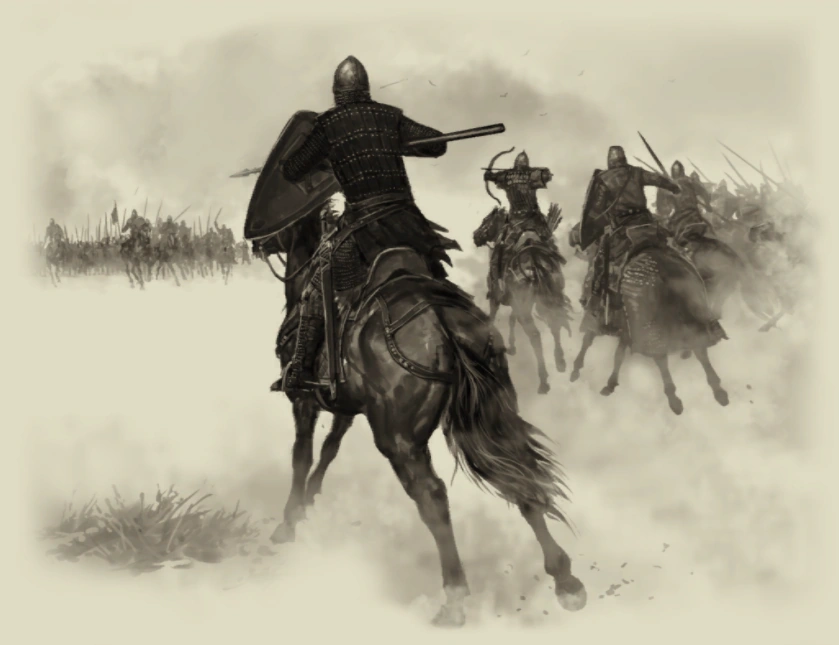
Battles are a large and frequent part of the Mount&Blade series. They help you progress through the game by generating experience, money, renown, loot, prisoners, and can directly increase weapon proficiencies.
Battles can be conducted in either of two ways:
- One of your options is to allow your troops to attack without you, allowing the game to generate your losses and the enemies' losses until one side emerges the victor. This is highly unfavorable however, as the calculator the computer uses often inflicts 1:1 casualties on your troops no matter what their quality is.
- The second option involves directly leading your troops in combat. This is the best way to engage in any battle because your presence can easily beat staggering odds.
To start a battle, you can attack the enemy or wait to be attacked. You can also join a battle already in progress between two other parties, but at least one of the parties must be either an ally or a neutral party and the other must be an enemy; you cannot join a battle between two enemies. There are some mods that allow you to join any battle, including one between two enemies.
At the end of the battle, you will receive the after action report which will tell you the casualties, allow you to take prisoners, and collect loot.
Terrain
The terrain of a battle varies, depending on where the battle takes place on the overland map.
Different terrain requires different tactics and formations.
- Rivers: These slow movement, and are good ambush spots for shock troopers like Nord Huscarls. Hiding your troops in riverbeds make the enemy's archer/cavalry tactics useless, forcing them to come down and fight in close combat. Rivers can reduce the effectiveness of cavalry like Swadian Knights because it effectively stops charges. They can also be used as protection for archers because the river gives them more time to strike distant targets before they become a threat. When submerged in deep water, breathing is not needed. Horses are completely immobile in water that covers their heads, though water this deep is not common.
- Plains: Good for cavalry, bad for infantry. Even the best Rhodok spearmen will find their party swarmed by horsemen. Place your archers/crossbowmen on any hills you find.
- Desert: Terrain varies from completely flat, to medium rolling hills. Like the plains, there is barely any vegetation or obstructions.
- Gorges: Just plains with some hills and bumps. Light cavalry will have more chance of victory against their heavy counterparts.
- Mountains: Dismount everyone. There's no point trying to ride the cliff mounted. Get your troops in a good formation on high ground.
- Forest: Same as gorges, but trees will make cavalry operations difficult. It doesn't really matter for heavy cavalry. Archers can have trouble hitting targets due to obstructions.
Commands
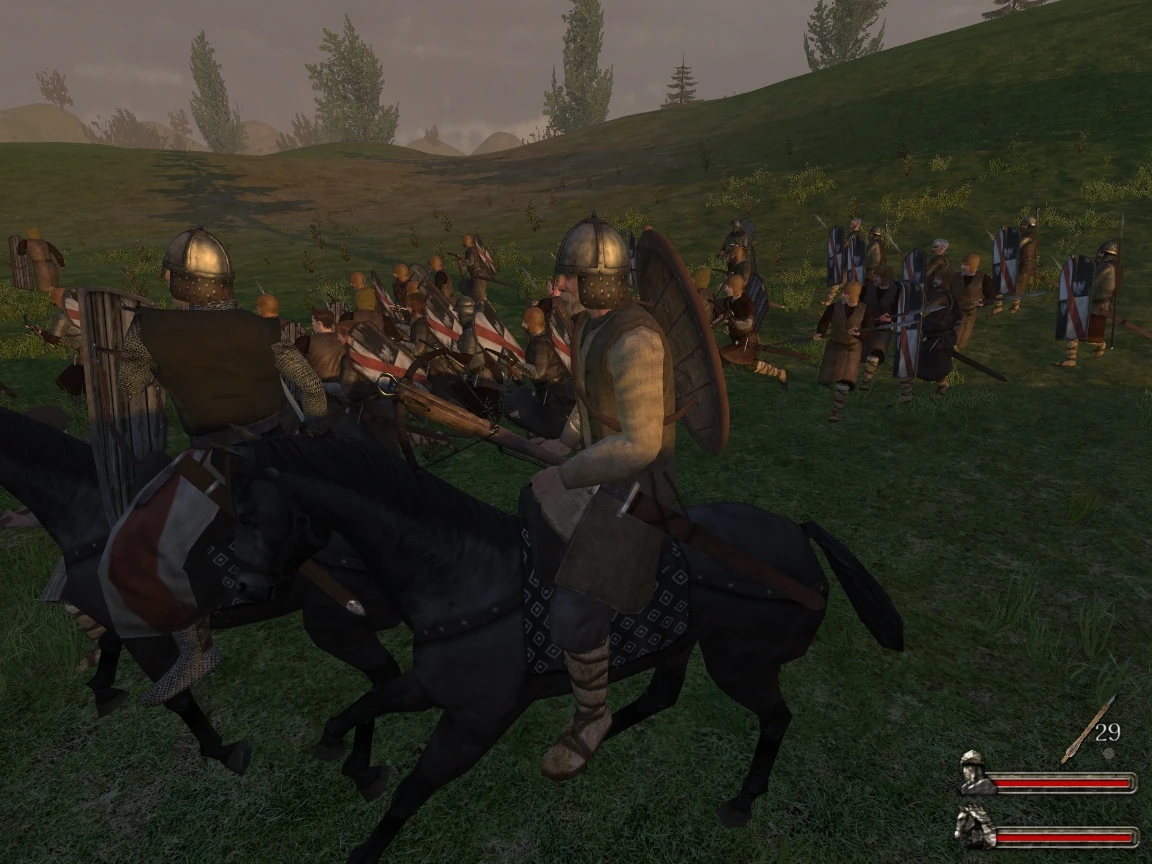

A small army formation
Using commands is another way to improve your chance of victory or to reduce your losses.
Using the number keys (default setting) you can select a portion of your army (such as your infantry, cavalry, or archers) and give them an order with the Function keys (F1-F11 with default settings) to hold a position or follow the player etc.
If you hold Shift, you can select more than one troop type at the same time.
Hit the Backspace key during the battle to see a list of all the available commands.
Unit Type
- 0 - Everyone
- 1 - Infantry
- 2 - Archers
- 3 - Cavalry
- 4 - The two unit types that were not previously selected (e.g. if Cavalry is selected, it will select Infantry and Archers)
Orders
- F1 - Hold this position
- F2 - Follow me
- F3 - Charge
- F4 - Mount/Dismount
- F5 - Hold Fire/Fire at Will
- F6 - Advance ten paces
- F7 - Fall back ten paces
- F8 - Tighter formation
- F9 - Looser formation
- F11 - Use only blunt weapons/Use weapons at will
Note: The above hotkeys are for classic Mount&Blade - Warband provides a different and broader set of options.
Formations
- (With Fire & Sword only)
- Line
- Square
- Wedge
- Circle
- Staggered
Tactics
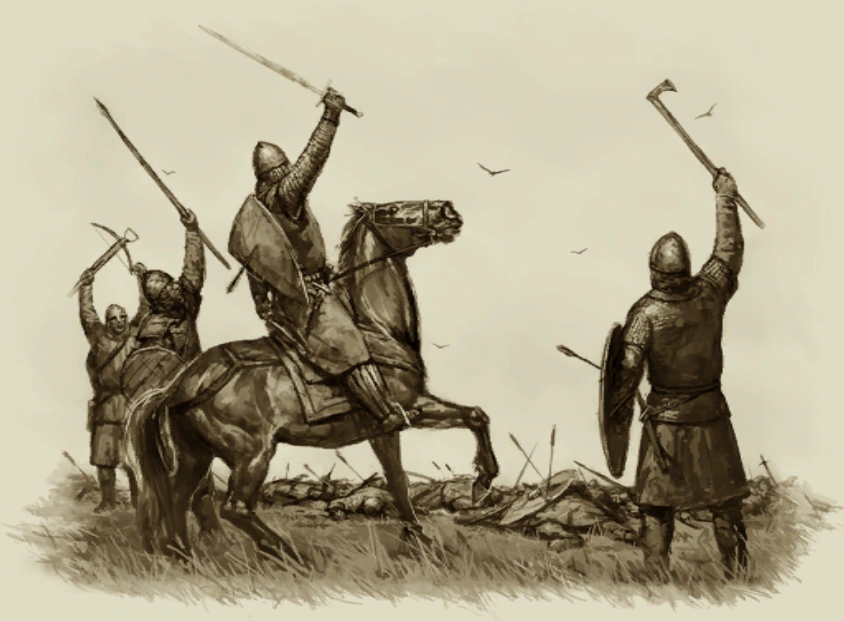
There are many things to consider when planning a battle, including your surroundings, your army composition, and your own style of play. These factors will determine your best course of action.
Here are some basic tactics that can be very useful.
Neutralizing enemies is not the only way to the victory. In Warband and With Fire & Sword, enemy units may flee the battle if their morale is reduced to a certain value.
Morale
Enemy units have their own morale value, which is determined by recent battle outcomes.
- Defeating lords and troops damages the entire army's morale.
- When their morale reaches a certain limit, they will run to the battlefield border and escape from the battle.
- Runaway enemies never fight back and destroying them damages the morale of the army too, causing further panic.
- Often a dramatic attack can damage the morale of the enemy greatly (e.g. a horse charge) - some soldiers will start to run away after getting a bit of damage.
- Runaway soldiers become Deserters (or Routed Enemies) later.
Enemies will not start running from battle until at least 45 seconds have passed.
Ranged Combat
Archers and crossbowman are much more effective when positioned on hills.
- All approaching units will be slowed by the terrain, allowing your ranged units to fire more shots at them.
- Cavalry will also be unable to gain the momentum that they use to charge and deliver heavy blows.
- It is important to note that placing your ranged troops on elevated ground will also make them targets for enemy ranged units.
- Placing archers in a single line and waiting for the enemy to get close, but not too close, before firing can cause devastating effect. At a close range, many enemies will die at once from projectiles, causing enemy troops to retreat.
Troops without ranged capability can avoid volleys of projectiles by being positioned behind hills.
- This is a very effective way of protecting your troops from archers and is especially useful if you don't like losing your poorly-shielded powerhouse units like Hired Blades.
- This may be a bad idea against cavalry as they will gain speed coming over the hill, increasing their damage when they meet your line.
Infantry
With heavily armored troops on foot, a slow advance can be best at times, such as against large numbers of ranged enemies.
- When using heavy infantry with large shields (most higher ranked Nordic troops for example), advancing slowly will cause them to march with shields raised. A charge when close will often doom the opposing archers/crossbowmen/skirmishers.
- If archers run out of ammunition, they will charge into your lines and be quickly killed.
Foot soldiers of any kind can benefit from being in a compressed formation when fighting cavalry.
- Tightening troop formations will remove the gaps that cavalry use to escape after landing a blow on your forces. This will cause the horses to stop dead, spelling almost certain doom for their riders.
- Cavalry who use projectiles will not be beaten this way. However, they will eventually run out of ammunition and charge, and will quickly fall.
Cavalry
Cavalry can be used to distract an enemy army while your other troops relocate.
- This works very well at the beginning of a battle if you wish to move your troops onto elevated ground or any other part of the map, however there is a good chance your cavalry will be lost if used this way.
- On the other hand, cavalry can be used as the core of your army. A full army of knights is basically unstoppable by any troops and, being the strongest of cavalry, knights will not lose to other cavalry.
- Cavalry can also be utilized quite effectively in a pincer attack. Have your infantry and archers advance/charge towards the enemy while telling your cavalry to follow you. Then try to circle behind the enemy formation, moving constantly to reduce the chances of archers hitting your mounted units. Once your infantry engages in combat with the enemy, either lead or tell your cavalry to charge in. Enemy formations attacked on multiple sides will usually weaken their morale, and allow you to kill them faster than if you just charged headlong into them.
If you order your infantry to hold position and keep formation, only their cavalry will charge and their infantry and archers will reach you much later. This will prevent your army from breaking up (when your advantage is similar/higher, this is always true).
- Pick off the soldiers on the flanks of the formation, and make them disorganized.
- When they are ordered to march slowly, they never swarm you and archers hold fire.
- Remember that the enemy cavalry will charge your troops anyway.
Outnumbered
If your advantage is miserable, any type of any troops of any kingdom will charge mindlessly against you.
- If this happens you're in trouble, but if you have a good army it is still possible to win. Enemies will be horribly disorganized and somewhat scattered, allowing an army of knights to run through them like paper. If you have a largely range-based army, you can tell your army to spread out and hold fire until the enemy gets close. When they do, begin firing and watch their scattered soldiers drop to the ground.
- Even Rhodok spear troops will run into you.
- Swadia always seems to have "prepare time" to line their cavalry before charge.
- This is the best chance to strike them without any resistance.
- Remember that once their cavalry successfully charge, your infantry casualties are inevitable.
Some less obvious strategies can win you fights that are insanely in enemy favor.
- If you fight anyone in a village, all of their troops will spawn without their horses. This will make for a quick slaughter of Khergit horsemen or even Swadian Knights.
- When you are defending a castle (before they are actually in battle with your castle), wait for the enemies to enter the castle (you must be waiting outside). You can attack the last few groups that are on the way to your castle and essentially cut their entire army in half as the soldiers in your castle already will not join this fight. You can help your castle against the other half right after.
- When you are defending a castle, hold your archers' fire until they start climbing the ladders or siege tower. This can improve your archers' accuracy and helps your archers save their ammunition.
- If you can, try using your infantry and knights to seal off the entrance to the castle blocking the way to your archers. In some cases, if you are heavily armoured and can deal deadly blows (esp. with a bardiche), you can go ahead of your infantry to greatly reduce the enemy's numbers before they can get to your infantry, knights, and finally your archers.
- Try positioning your archers and infantry on a very high ground to reduce cavalry effectiveness. Try charging your enemies with knights at the start of a battle to stop their charge attacks. Also, try taking out their archers and infantry first before going for the cavalry.
- If you find you do not like the terrain you are currently fighting on, you can retreat (before they get too close; you will lose troops if you wait too long). There will be 3 different maps that will rotate as you retreat. Find your favorite one (perhaps one with a river if you have a lot of archers) and defeat your opponents on it.
- If you have a lot of archers (or perhaps a pure archer army), you can retreat before the enemies get too close and they will start far away again when the battle is re-engaged. You can do this repeatedly until you have killed thousands of troops if you desire, so long as they don't have many good archers in their army (this also reduces your renown reward if you hit and run; choose reward versus saving troops).
- Use obstacles to stop cavalry charges. Rocks on the field, trees, idle horses, and even your battle standard where you start will stop cavalry in their tracks. You can defeat Khergit armies on flat terrain with strategies like this - even when you only have archers and/or infantry.
- If you are skilled at horse archery, have a fast/maneuverable horse or can take hits, you can duck and weave, picking off enemy troops at the edges of their formations while their archers run out of ammo. This can take a lot of practice and is not recommended for any but the most desperate of times (such as caught by much larger army and you didn't retreat in time to save your own).
Autocombat (Simulated Battles)
Warband
One way to fight battles is just ordering your troops to attack without you (more or less the same mechanics is also used for resolving battles between 2 NPC parties). In this case, the game simulates a battle. It's done in several repetitive rounds, each of which consists of the following steps:
- Calculating strength of both parties which is done by summing up strength of all non-wounded units. A unit's strength equals to ((unit_level + 4)^2)/50 but no less than 1. So a level 4 Peasant's strength equals 1 while a level 27 Sarranid Mamluke's strength equals 19.
- Using total strength numbers from both parties to respectively inflict damage (killed & wounded) on both parties. This part is done by game engine and the exact execution is unknown but generally at this step the game favors large parties (even if they consist of low-level units) over small parties (even if it's elite units) which resulted in a popular myth that autocombat doesn't take units' levels into account. It does, it just doesn't give them enough "credit".
If neither of 2 parties is defeated after the 2nd step, their remaining strength is recalculated and the process is repeated until 1 of 2 parties runs out of battle-ready units.
Tips and Trivia
- Your horse can double as a meat shield but will run away after being damaged. This tactic is of little use unless your horse is an arrow-proof Charger.
- Strong armor is very important if you play on normal settings.
- Angle your shield towards the direction of incoming fire when charging an archer line (up if above, down if below). Also, if enemy archers are firing at you from a distance, angle your shield up; there's no way for them to fire straight at you, only in an arc.
- Fighting in the front lines will give you quick access to fallen weapons that can replenish your ammunition or give you an edge versus certain opponents (piercing weapons against heavily armored foes).
- Whenever possible, fight on a horse. Mounted combat against infantry gives you the advantage of speed against them, allowing you to land a blow, escape, then rinse and repeat. In addition, a horse charging an infantryman will knock him out of guard and do a little blunt damage.
- Attacking an enemy's ranged troop line will make most of them switch to melee, possibly giving your troops a breather from their fire. Bring some mounted friends and step on some toes while chopping off heads. Remember not to get stuck though.
- If your troops are weak and you are fighting against superior forces, never forget to attack first yourself and kill as many enemies as you can before you order your troops into the battle.
- In the beginning of the game (but not just after you've started) get some recruits and attack a small (6-8 members) Sea Raider party. Most of your men may die, but this tactic will help you to gain good equipment (which will sell for a very good price) and a large amount of experience.
- If you are a horse archer fighting against troops with archers, try taking their dropped arrow bags. However if the enemy archers switch to melee weapons, they won't leave bags of arrows or crossbow bolts behind, so keep that in mind if you're trying this method.
- In sieges and similar battles, you can replenish your stocks from projectiles embedded in obstacles or in the ground (one at a time, however). This can help if fighting crossbowmen as an archer (Warband only).
- Often you can stall enemy charges or turn around enemies so that their shields are facing the wrong way by riding ahead of your army. This can make your cavalry charge deadly against Rhodoks because they are not paying attention to all of your cavalry. This also doubles as a way to make enemies stop at some distance from your archers (often with their shields the wrong way). However, be careful to not get hit (especially from projectiles).
- Be careful when ordering your troops to attack without you, as many units are less effective in the simulated battle versus the actual battle.
See Also
- Strategy and tactics: General combat and faction specializations
- Player tactics: Specific combat tips and tricks